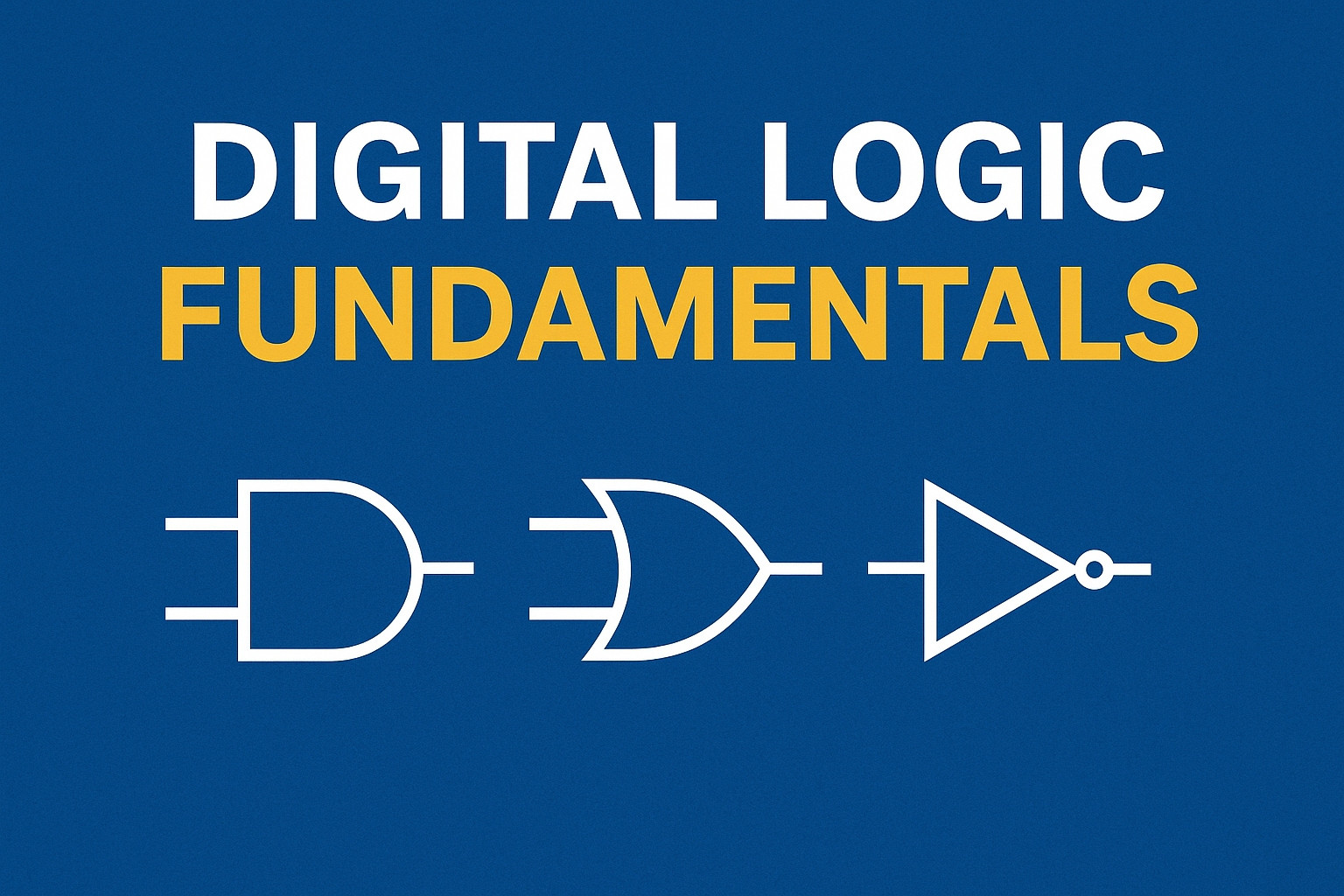
Unit 1: Number Systems & Boolean Algebra Binary, Octal, Decimal, Hexadecimal conversions Binary arithmetic and complements Boolean operations and theorems Canonical forms (SOP, POS), minterms/maxterms Unit 2: Logic Gates & Minimization Basic gates: AND, OR, NOT Universal gates: NAND, NOR XOR and XNOR operations Boolean simplification and Karnaugh Maps (K-Maps) Unit 3: Combinational Circuits Adders, subtractors, comparators Multiplexers, demultiplexers Encoders, decoders Code converters (Binary/Gray, BCD, Excess-3) ALU basics Unit 4: Sequential Circuits Latches and Flip-flops (SR, JK, D, T) Registers (SISO, SIPO, PISO, PIPO) Counters (asynchronous, synchronous, modulo-n) Timing diagrams & clocking concepts Unit 5: Memory & Logic Families RAM, ROM, Cache, Flash memory Programmable Logic Devices (PLA, PAL, FPGA) Logic families: TTL, CMOS, ECL A/D & D/A converters
Digital Logic Fundamentals introduces the foundational principles required to understand, analyze, and design digital systems. This course covers number systems, Boolean algebra, logic gates, combinational and sequential circuit design, and memory components. Students learn how digital information is represented, processed, and stored in computers and embedded systems. The course develops problem-solving and circuit-design skills essential for computer science, electronics, and engineering applications.

0 Reviews
my self Im Iswarya working Assistant Professor in GVN College ,department of computer Science ,thank you